Identity Threat Detection & Response
Most modern breaches do not crack a password — they steal a session. Addicnet monitors identity and authentication activity across Microsoft 365 and Google Workspace, correlates it with email, endpoint and browser evidence, and cuts off attacker access automatically when an account is compromised.
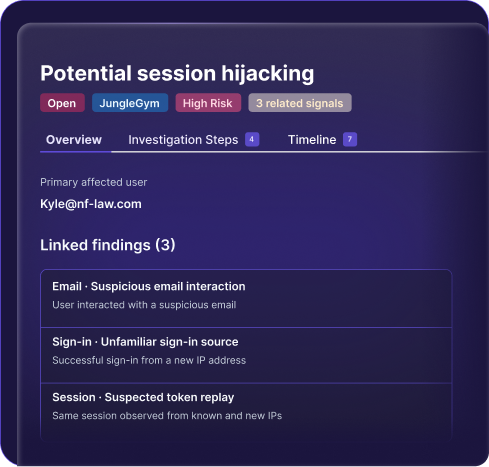
One signal is noise. Three signals are a pattern.
Powered by Microsoft 365 · Google Workspace
Attacks built to blend in.
Credential & token theft
Stolen credentials and session tokens give attackers legitimate-looking access, even with MFA enabled.
Session hijacking
Compromised cookies let an attacker take over an active session without triggering a traditional alert.
Adversary-in-the-middle
Fake login pages relay authentication and capture session tokens, bypassing MFA entirely.
Business email compromise
A compromised identity becomes the launch point for fraud, impersonation and payment redirection.
Data exfiltration
Sensitive information is quietly moved out of inboxes, cloud storage and business applications over time.
Authentication bypass
Legacy authentication methods create paths around the controls protecting modern identities.
From signal to response.
Detect
Identities, authentication events, mailbox activity and cloud services are monitored continuously rather than sampled.
Correlate
Unfamiliar sign-in properties, new external forwarding rules and suspected token replay become one incident with context.
Respond
Policies suspend the account and revoke the session automatically as soon as multiple signals indicate compromise.
Investigate
A single timeline shows what happened and in what order, instead of an analyst rebuilding the attack from alerts.
What is included.
- Continuous monitoring of Microsoft 365 and Google Workspace identities
- Behavioural baselining per user, role and location
- Cross-signal correlation across identity, email, endpoint and browser
- Automated account suspension and session revocation
- Inbox rule, forwarding and MFA posture review
- Incident timeline and forensic evidence for review
What changes for your business.
Containment before the investigation
Compromised accounts are cut off as soon as the pattern is clear, so the attacker cannot keep working while you review.
One incident, not four alerts
Mailbox, session and endpoint evidence is tied to the affected user, cutting triage from hours to minutes.
Evidence you can hand over
Each incident keeps its own record of signals, actions and outcomes — useful for insurers, auditors and customers.
Controls that work alongside this one.
Email Security
API-based protection against phishing, impersonation and business email compromise, connected to the identities behind the inbox.
Explore controlBrowser Security
Block phishing, malicious extensions and data leaking into AI tools — inside the browser session, before anything is entered.
Explore controlEndpoint Security
AI-driven endpoint detection and response on every device — ransomware, fileless attacks and zero-days contained in real time.
Explore controlQuestions we are asked.
Do we need to change our identity provider?
No. The controls connect to the Microsoft 365 and Google Workspace tenants you already run through API access. Your identities, mailboxes and policies stay where they are.
Can automatic response lock out our staff?
Containment runs against policies you approve during onboarding. A suspension is reversible in one action, and high-risk responses are reviewed by an analyst where you prefer a human decision first.
Does this work with conditional access and MFA?
Yes. Identity controls sit alongside your existing MFA and conditional access settings, and gaps in that configuration are surfaced as findings for review.
Let's simplify your cloud infrastructure.
Tell us about your business and infrastructure requirements. Our team will assess your needs, recommend an approach and prepare a proposal.